
Key Takeaways
- Freytag pyramid leadership helps executives structure change narratives with tension, movement, and resolution.
- The model is useful when teams understand the strategy but do not feel the urgency.
- Senior leaders should not manufacture drama, but they must name real stakes.
- The best leadership stories move from context to conflict, choice, action, and consequence.
- Freytag pyramid leadership works when narrative is matched by operational decisions.
Freytag pyramid leadership gives technology executives a practical way to explain why change matters, where the tension is, and what action must happen next. I have seen strong strategies lose energy because leaders presented them as information instead of movement. When the story has a shape, people can follow the work with more confidence.
Why Freytag Pyramid Leadership Matters In Strategic Change
Freytag’s Pyramid is usually taught as a dramatic structure: exposition, rising action, climax, falling action, and resolution. In business, I do not use it to make leadership theatrical. I use it to make leadership clearer.
Most executive communication is heavy on exposition. Leaders explain the market, the roadmap, the operating model, the budget, and the metrics. All of that matters. But exposition alone does not create movement.
A technology leader once showed me a transformation deck with more than 70 slides. It was accurate, detailed, and almost impossible to feel. We rebuilt the story around one tension: the company wanted product speed, but its architecture rewarded local workarounds. Suddenly, the transformation had a spine. The work had not changed. The meaning had.
That is the power of Freytag pyramid leadership. It helps leaders turn strategy from a pile of facts into a sequence people can understand.
This is especially relevant now. McKinsey’s 2025 article on the CEO’s role as chief storyteller argues that leaders must set communication standards, embody purpose, and speak clearly in moments that matter. I believe the same expectation now sits with CIOs, CTOs, product leaders, data leaders, and engineering executives.
Freytag Pyramid: Leadership Starts With Exposition
Exposition answers: where are we?
In executive communication, exposition should be short, concrete, and honest. It sets the scene without drowning people in background.
Weak exposition sounds like this:
“We are operating in a dynamic environment of digital disruption.”
Stronger exposition sounds like this:
“Our customers now expect weekly product improvements, but our release model was built for quarterly coordination.”
The second version creates a shared reality. It avoids vague language. It gives people a problem they can recognize.
This is where I often see senior leaders struggle. They either over-explain because they want everyone to have the full context, or they under-explain because they assume the context is obvious. Neither works.
Good exposition names:
- The business reality.
- The human impact.
- The strategic constraint.
- The cost of staying the same.
HBR’s 2025 piece on jargon hurting strategy makes a useful point: strategy language can become fog when words meant to unify create confusion. Freytag pyramid leadership helps leaders replace fog with scene-setting.
Rising Action: Where Freytag Pyramid Leadership Creates Urgency
Rising action answers: What pressure is building?
This is the part many executives avoid. They want alignment without discomfort. But real alignment often begins when people understand the tension.
For technology leaders, rising action might include:
- Technical debt slowing customer delivery.
- AI pilots creating activity without adoption.
- Security risk increasing faster than governance maturity.
- Product teams depending on platforms that are not yet reliable.
- Managers carrying change without enough support.
The key is to name the tension without blame. Rising action is not a villain hunt. It is a leadership discipline.
Deloitte’s 2025 Global Human Capital Trends describes the modern workplace as a set of tensions between business and human outcomes. That is exactly why Freytag pyramid leadership matters. Leaders need to explain the tension clearly enough that people stop treating change as optional noise.
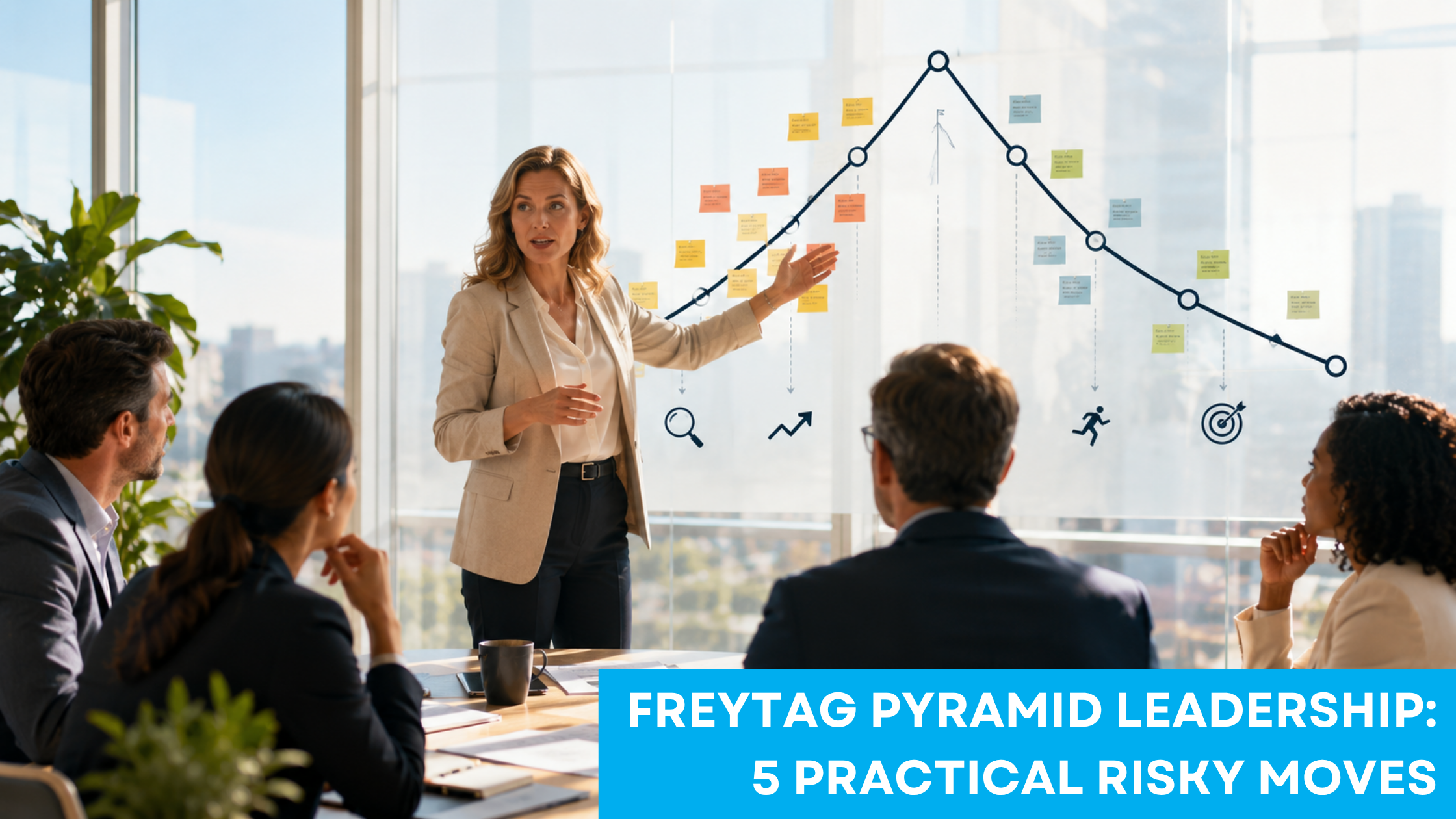
| Story Element | Leadership Question | Executive Example |
| Exposition | Where are we? | “Our operating model was built for a slower market.” |
| Rising action | What pressure is building? | “Customer needs are changing faster than our decision rhythm.” |
| Climax | What choice must we make? | “We must choose platform discipline over local optimization.” |
| Falling action | What happens after the choice? | “Teams will change funding, governance, and release habits.” |
| Resolution | What becomes possible? | “We can learn faster and serve customers with less friction.” |
The Climax Is The Leadership Choice
In Freytag’s Pyramid, the climax is the turning point. In leadership, it is the decision.
This is where many transformation stories weaken. Leaders explain the context and the pressure, then avoid naming the real choice.
A climax should sound like a commitment.
“We will standardize the platform foundations, even when local customization feels faster.”
“We will redesign work around AI, not simply add tools to old workflows.”
“We will make fewer priorities visible so teams can finish what matters.”
This is where influence without authority becomes relevant. Senior technology leaders often need to create movement across functions they do not fully control. A clear turning point helps stakeholders understand what choice is being made and what support is needed.
Freytag pyramid leadership is useful because it forces the executive team to stop hiding behind general ambition. If the story has no turning point, it is probably not a strategy story yet.

Falling Action Turns The Choice Into Operating Reality
Falling action answers: what happens now?
This part is not as dramatic as the climax, but it is where credibility is built. After a leadership choice, people want to know what will change.
For example:
- Which meetings disappear?
- Which metrics change?
- Which teams get decision rights?
- Which trade-offs will be made publicly?
- Which behaviors will senior leaders model?
If leaders skip this stage, teams fill the gap with speculation. They may support the message in principle while continuing old habits in practice.
Freytag pyramid leadership helps leaders show the consequences of the choice. It turns the story into an operating rhythm.
Resolution Must Be Earned
Resolution answers: what becomes possible?
The mistake is treating resolution as a happy ending. In leadership, resolution is not applause. It is capability.
A strong resolution sounds like this:
“By the end of this work, product teams will be able to launch safer changes weekly without rebuilding the same platform capabilities.”
That sentence is useful because it names a future ability. It does not simply say the organization will be “more agile.”
Resolution also gives teams a reason to endure the difficult middle. People can handle discomfort when they believe it leads somewhere real.
Freytag pyramid leadership helps senior technology leaders create strategy narratives with shape, urgency, and consequence. It does not ask leaders to be dramatic. It asks them to be clear about context, tension, choice, action, and resolution. In a world of AI disruption, transformation fatigue, and overloaded teams, Freytag’s pyramid leadership gives executives a practical way to turn scattered information into movement people can understand and trust.