Key Takeaways
- Pixar story framework helps leaders turn strategy into a clear sequence people can remember.
- The framework is useful when executive communication feels too abstract or overloaded.
- Technology leaders can use it to explain change, AI adoption, platform strategy, and operating model shifts.
- The strongest version names the old pattern, the disruption, the consequence, the decision, and the new direction.
- The Pixar story framework works when simplicity sharpens truth, not avoids complexity.
Pixar story framework is a practical way for senior technology leaders to make strategy easier to understand and repeat. I have seen teams align faster when leaders stop explaining every detail first and instead give people a simple narrative sequence. In complex work, simplicity is not childish; it is disciplined.
Why Pixar Story Framework Works For Executive Communication
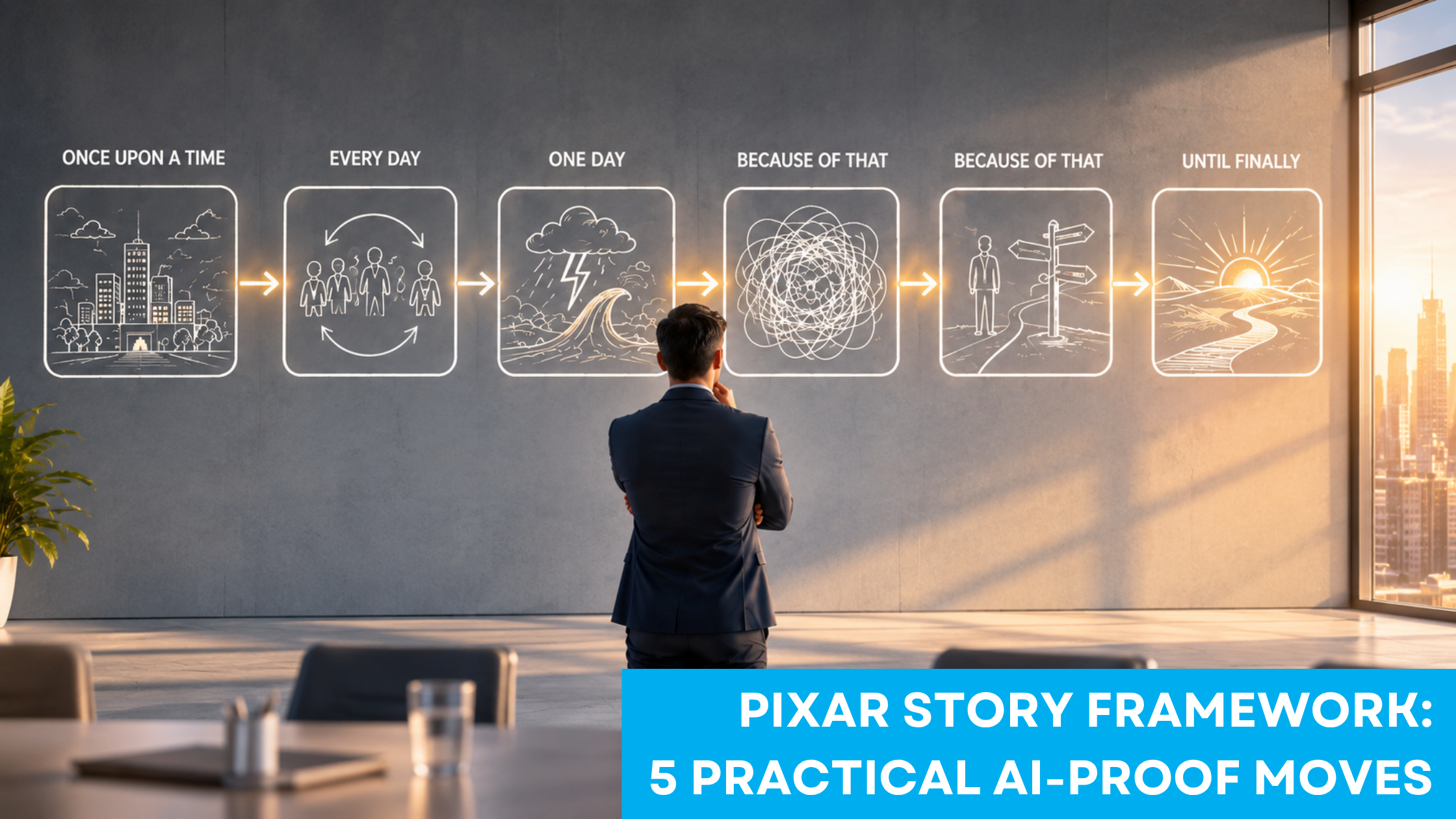
The Pixar story framework is often summarized as a sequence:
Once upon a time…
Every day…
One day…
Because of that…
Because of that…
Until finally…
For executives, I adapt it into leadership language:
- Here is the world we were operating in.
- Here is the pattern we repeated.
- Here is what changed.
- Here is what that change caused.
- Here is the decision we must make.
- Here is what becomes possible.
This structure works because it respects how people process change. They do not absorb strategy as a list of initiatives. They build meaning through sequence.
A CTO once asked me to review a message about engineering transformation. The original version had pillars, OKRs, governance, and principles. All useful. But nobody could repeat it. We rebuilt it with a Pixar-style sequence: “For years, we optimized for local delivery. Every team solved its own constraints. Then our customer expectations changed. As a result, local speed began creating enterprise drag. Because of that, we are moving to shared platform foundations.” The message became usable.
That is the value of Pixar story framework. It makes the logic of change portable.
McKinsey’s 2025 article on the CEO’s role as chief storyteller points to the need for leaders to create clear narratives across stakeholders. Technology executives need the same capability because their choices now shape enterprise strategy, customer experience, and trust.
Pixar Story Framework Starts With The Old Pattern
The first part of the story is not the future. It is the current pattern.
Leaders often rush to the vision because they want to inspire. But people need to understand what pattern is being disrupted.
For example:
“Every team built its own workflow.”
“Every product group optimized for its own roadmap.”
“Every AI pilot created local learning but little enterprise scale.”
“Every approval layer was added for a reason, but together they now slow decisions.”
This is where the Pixar story framework becomes useful. It helps leaders name the everyday pattern without blame. The pattern may have been reasonable in the past. It may even have created success. But the story shows why it is no longer enough.
This tone matters. If leaders attack the old pattern too aggressively, teams feel judged for work they were once rewarded to do. If leaders defend the old pattern too strongly, nothing changes.
The right message is: this pattern got us here, and now it cannot get us there.
The Disruption Creates The Story
In the Pixar structure, “one day” changes everything. In leadership, this is the disruption.
For technology executives, the disruption might be AI, margin pressure, customer expectations, security risk, regulatory change, or a shift in product strategy.
The point is not to dramatize the disruption. The point is to name it clearly.
HBR’s article on jargon hurting strategy warns that abstract strategy language can create confusion instead of alignment. “Digital transformation” is abstract. “Customers now expect changes in days while our release process still thinks in quarters” is concrete.
The disruption should create a clear before-and-after.
| Pixar Element | Executive Translation | Example |
| Once upon a time | The strategic context | “Our model worked when markets moved slower.” |
| Every day | The repeated pattern | “Teams optimized locally to deliver faster.” |
| One day | The disruption | “Customer expectations changed, and AI accelerated the pace.” |
| Because of that | The consequence | “Local optimization began creating enterprise complexity.” |
| Because of that | The leadership choice | “We need shared foundations and clearer decision rights.” |
| Until finally | The future capability | “Teams can move faster without rebuilding the same work.” |
Using Pixar Story Framework For AI Transformation
AI transformation needs this structure because the topic is overloaded.
If leaders start with tools, people think tactically. If leaders start with fear, people defend. If leaders start with hype, people distrust. The Pixar story framework gives the message a cleaner path.
For example:
“Once, our teams did most analysis, documentation, and coordination manually. Every day, talented people spent hours turning fragmented information into decisions. One day, AI became good enough to change that work. Because of that, we need to redesign workflows, not simply add tools. So we start with use cases where quality, speed, and judgment can be measured. Until finally, teams spend more time on customer insight and less time on repetitive coordination.”
That is a stronger AI message than “we are scaling AI adoption.”
Deloitte’s 2025 work on AI and work design argues that organizations miss value when they layer AI onto legacy work rather than redesigning roles and workflows. The Pixar story framework helps leaders explain that shift in a way people can follow.
It also helps with trust. People hear that the leader understands the human work, not just the technology.

Pixar Story Framework And Executive Presence
Executive presence is not about sounding impressive. It is about helping people feel oriented in an important moment.
That is why I often connect this work with the 3Cs of executive presence. Clarity helps people understand the story. Composure helps them trust the leader. Connection helps them see their role.
The Pixar story framework supports all three.
It creates clarity by sequencing the message.
It supports composure because the leader does not need to over-explain.
It builds connection because the story starts from a shared pattern people recognize.
The danger is oversimplification. A simple story should not become a simplistic story. The leader must still name trade-offs, risks, and constraints.
A good executive story makes complexity navigable. It does not pretend complexity disappeared.
A Practical Pixar Story Framework Exercise
Here is the exercise I use with senior leaders.
Complete these six prompts:
Once, we operated in a world where…
Every day, our teams…
One day, something changed…
Because of that, we can no longer…
Because of that, we are choosing to…
Until finally, we will be able to…
Then revise the language for executive use.
Remove anything that sounds cute. Replace vague nouns with concrete realities. Add one trade-off. Add one example. Make sure the story can be repeated by a manager without a script.
For example:
“Once, our architecture supported a smaller product portfolio. Every day, teams built local solutions to meet customer needs quickly. One day, our portfolio scaled and customer expectations accelerated. As a result, local solutions began creating shared risk. Because of that, we are investing in platform foundations and clearer engineering standards. Until finally, teams can deliver faster with less hidden complexity.”
That is not a full strategy. It is the spine of the strategy.
Common Mistakes With Pixar Story Framework
The first mistake is making it too playful. This is not a children’s story. It is an executive sequencing tool.
The second mistake is skipping the old pattern. If people do not recognize the starting point, they will not trust the change.
The third mistake is using “one day” as a vague disruption. Be specific. What changed? Customer behavior? AI capability? Cost structure? Risk? Competition?
The fourth mistake is making the ending too broad. “We will be more innovative” is not enough. Name the capability.
The fifth mistake is leaving out consequences. “Because of that” is where the work becomes real. It shows that one thing leads to another.
Pixar story framework helps technology executives communicate strategy with sequence, simplicity, and credibility. It is not a replacement for rigorous planning. It is the spine that helps people understand why the plan matters. In a world of AI disruption, platform complexity, and transformation fatigue, the Pixar story framework gives leaders a practical way to make change memorable enough to repeat and clear enough to act on.