

Key Takeaways
- BLUF communication reduces executive decision friction.
- Leaders improve alignment when they present conclusions first.
- The BLUF framework helps technical leaders communicate with business stakeholders.
- Concise communication increases trust during high-stakes conversations.
- Teams respond faster when actions and decisions are clear.
BLUF framework leadership communication helps executives present the conclusion first so stakeholders can act faster and align quickly. Leaders in technology, engineering, and product organizations increasingly rely on concise messaging because attention spans are shrinking while decision complexity keeps growing. Strong communication discipline now influences execution speed as much as technical expertise.
Why the BLUF Framework Matters for Leaders
The BLUF method stands for “Bottom Line Up Front.” It originated in military communication where speed, clarity, and precision directly affected operational outcomes.
Today, the same communication pressure exists inside modern organizations.
Executives manage overloaded calendars, fragmented teams, and constant context switching. Most leaders do not lack intelligence or expertise. They lack communication efficiency.
A CTO explaining a platform migration to the board cannot afford a ten-minute buildup before revealing the recommendation. A VP of Engineering presenting delivery risks cannot bury the critical issue in slide 14.
High-performing leaders communicate conclusions first.
One enterprise product leader shared a lesson after a failed steering committee presentation. He spent twenty minutes explaining technical dependencies before revealing that the launch date would slip by six weeks. The executives focused less on the explanation and more on why the key message arrived too late. After adopting BLUF, escalation meetings became shorter, and decisions accelerated.
The BLUF framework leadership communication approach works because it respects executive attention.
It immediately answers three questions:
- What is happening?
- Why does it matter?
- What action is needed?
That structure improves trust because stakeholders feel informed rather than managed.
What the BLUF Framework Actually Means
Many leaders misunderstand BLUF.
BLUF does not mean removing nuance.
It means prioritizing the conclusion before supporting context.
The structure is simple:
| BLUF Element | Purpose | Example |
| Bottom Line | Deliver the conclusion immediately | “We should delay the release by two weeks.” |
| Context | Explain the supporting rationale | “Security vulnerabilities remain unresolved.” |
| Impact | Clarify business implications | “A rushed launch increases regulatory risk.” |
| Action | Define the next step | “Approve additional testing resources today.” |
This communication style creates clarity under pressure.
The strongest executive communicators understand that leadership communication is not about showcasing analysis depth. It is about enabling confident decisions.
BLUF also supports executive presence because concise leaders appear more prepared, strategic, and decisive.
For leaders seeking to strengthen their influence at senior levels, this related guide on executive stakeholder communication offers additional frameworks.
Where Leaders Fail in Executive Communication
The most common communication mistake among technical leaders is chronological storytelling.
They explain events in the order they discovered them, rather than in the order stakeholders need to hear them.
That creates unnecessary cognitive load.
Consider this example:
“Over the past three weeks, the infrastructure team identified several authentication inconsistencies during the migration assessment. After reviewing the dependencies, we discovered additional integration constraints with third-party vendors. Security teams then requested another compliance review.”
Only after several minutes does the speaker finally reveal:
“We recommend postponing the migration.”
That approach weakens confidence.
Executives interpret delayed conclusions as uncertainty.
The BLUF framework leadership communication model reverses the structure:
“We recommend postponing the migration by two weeks due to unresolved security and integration risks. Here are the three reasons.”
Now the audience immediately understands the purpose of the discussion.
Leaders also fail when they overcomplicate communication with excessive detail.
Senior stakeholders rarely need every operational input.
They need:
- Risks
- Tradeoffs
- Impacts
- Recommendations
- Decisions required
Concise communication demonstrates strategic judgment.
Research from MIT Sloan Management Review continues to highlight how leadership clarity directly affects organizational alignment and the quality of execution.
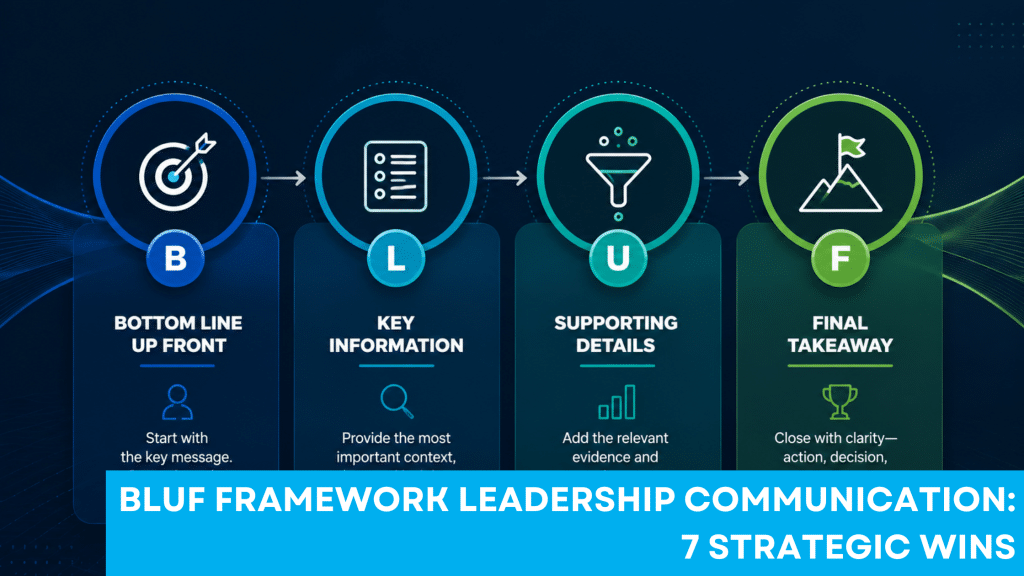
How to Structure BLUF Communication Effectively
The BLUF framework leadership communication approach becomes powerful when leaders apply it consistently across meetings, emails, presentations, and escalations.
Start With the Decision
Lead with the recommendation or conclusion.
Examples:
- “We should pause the rollout.”
- “Customer churn risk increased this quarter.”
- “The hiring freeze will impact roadmap delivery.”
- “We recommend consolidating vendors.”
Strong leaders remove ambiguity immediately.
Add Relevant Context Only
After presenting the bottom line, provide supporting information.
Keep context focused.
Executives do not need every operational detail.
They need enough information to evaluate risk and confidence.
A useful rule:
If the detail does not influence the decision, remove it.
Clarify Business Impact
This is where many technical leaders struggle.
They explain technical issues without translating business consequences.
Instead of saying:
“The API response latency increased by 32%.”
Say:
“Customer checkout performance degraded, increasing abandonment risk during peak traffic.”
Business framing strengthens executive communication credibility.
End With Clear Action
Every BLUF communication should conclude with a next step.
Examples:
- “Approval is needed by Friday.”
- “The leadership team should align on priority tradeoffs.”
- “Additional funding is required for remediation.”
Clarity drives momentum.
BLUF Examples for Technology Leaders
The BLUF framework leadership communication model becomes especially valuable in technical organizations where complexity can overwhelm stakeholders.
Example 1: Engineering Escalation
Weak Version
“The engineering team encountered infrastructure instability after the deployment sequence triggered inconsistent authentication behavior in the staging environment.”
BLUF Version
“We should delay deployment by 48 hours because authentication instability creates customer access risk.”
The second version creates immediate clarity.
Example 2: Budget Discussion
Weak Version
“Our cloud infrastructure costs increased due to several operational factors connected to expanded workloads.”
BLUF Version
“We need a 12% infrastructure budget increase to support AI workload expansion without reducing system reliability.”
Example 3: Product Prioritization
Weak Version
“The roadmap review identified competing priorities between platform modernization and customer-facing features.”
BLUF Version
“We recommend prioritizing platform modernization this quarter because reliability issues now threaten enterprise retention.”
Strong BLUF communication accelerates:
- Executive alignment
- Cross-functional collaboration
- Stakeholder trust
- Faster decisions
- Reduced meeting fatigue
When Leaders Should Avoid Overusing BLUF
The BLUF framework leadership communication model is powerful, but leaders should avoid applying it mechanically.
Some conversations require emotional intelligence, nuance, or collaborative discovery.
For example:
- Sensitive performance conversations
- Organizational restructuring discussions
- Crisis communication involving layoffs
- Coaching and mentorship sessions
In these moments, abrupt conclusions can feel transactional.
Strong leaders adapt their communication style to the context.
BLUF works best when:
- A decision is required
- Stakeholders need fast alignment
- Risk or urgency exists
- Executive attention is limited
- Clarity matters more than exploration
It works less effectively when the primary objective is empathy, brainstorming, or relationship repair.
Communication maturity involves knowing when to compress information and when to expand dialogue.
Building a BLUF Communication Culture
Organizations benefit when BLUF becomes a team-wide discipline rather than an individual habit.
Leaders can operationalize BLUF communication through simple practices.
Standardize Executive Updates
Encourage teams to begin updates with:
- Decision required
- Current status
- Key risk
- Recommended action
This structure reduces ambiguity across leadership layers.
Reinforce Concise Writing
Long messages often signal unclear thinking.
Encourage leaders to shorten:
- Status updates
- Escalation emails
- Steering committee presentations
- Leadership summaries
Clarity improves operational velocity.
Coach Teams to Translate Technical Risk
Technical depth matters.
But executive communication requires business translation.
Engineering leaders should train teams to connect technical decisions to:
- Revenue
- Customer impact
- Operational continuity
- Compliance exposure
- Strategic priorities
That shift dramatically improves stakeholder influence.
Reward Clarity Publicly
Culture changes faster when leaders visibly reinforce behaviors.
When someone delivers a concise and effective executive update, acknowledge it.
Communication standards become contagious.
Over time, organizations with strong communication discipline move faster because fewer decisions remain trapped inside confusion.
BLUF framework leadership communication helps executives communicate with greater precision, credibility, and strategic impact. Leaders who present conclusions first reduce confusion, accelerate alignment, and improve decision quality across organizations.
In modern technology environments, communication clarity is no longer optional. It directly influences execution speed, stakeholder trust, and leadership effectiveness.
The leaders who stand out are rarely the ones who speak the longest.
They are the ones who communicate the clearest.