Key Takeaways
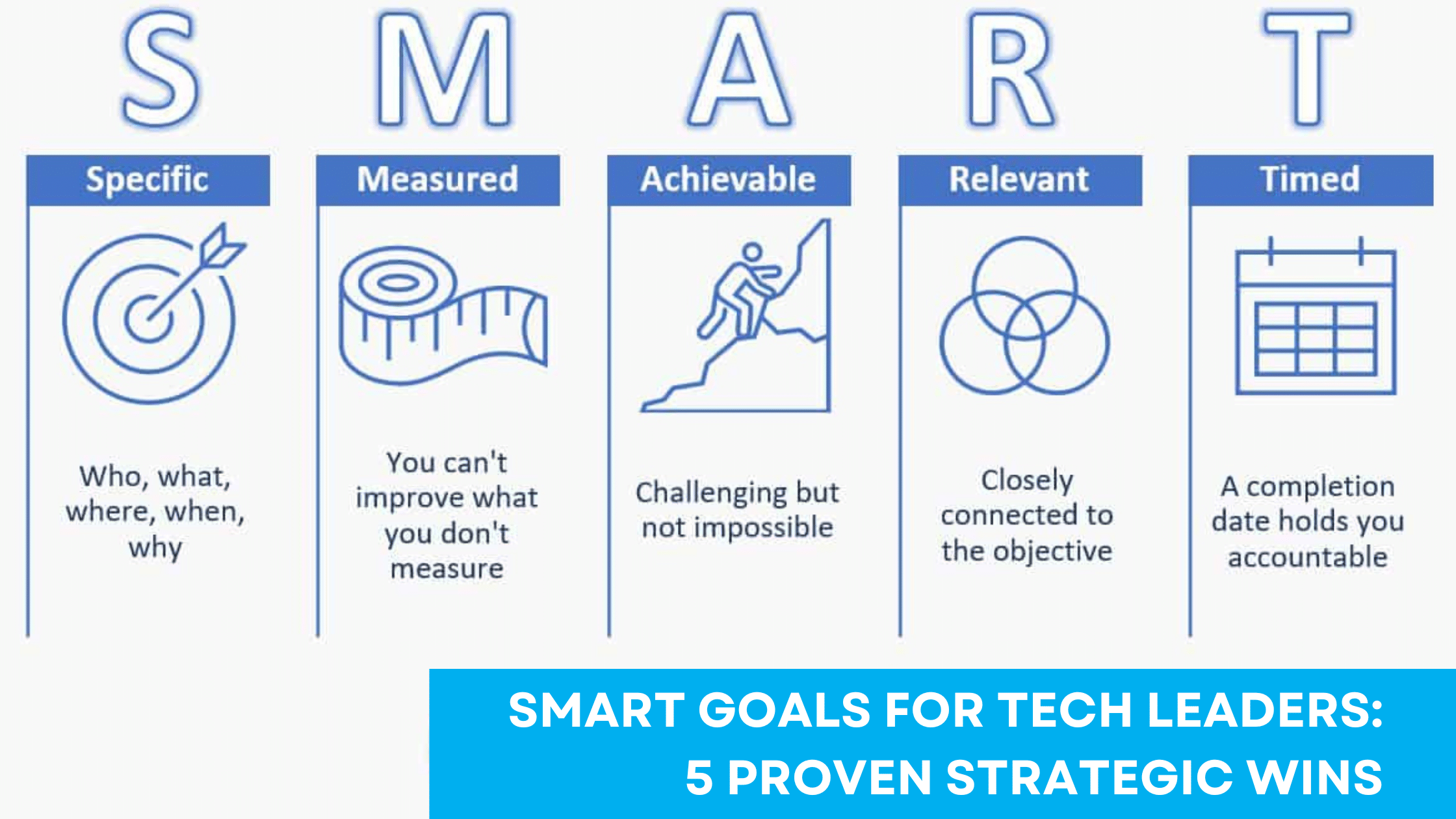
- SMART Goals for Tech Leaders convert vague intent into Specific, Measurable, Achievable, Relevant, and Time-bound objectives.
- The framework fails most often through tunnel vision and sandbagging — leaders set safe targets to guarantee a win.
- SMART works best for individual execution; pair it with OKRs when you need cross-team strategic alignment.
- Five strategic wins: roadmap clarity, fair performance reviews, faster decisions, talent development, and stakeholder trust.
- A SMART goal is only as good as its review cadence — write it once, revisit it often.
SMART Goals for Tech Leaders remain one of the most reliable tools for turning ambition into measurable delivery, yet most engineering and product leaders apply the framework loosely enough that it loses its edge. Used well, it sharpens roadmaps, defends performance reviews, and builds stakeholder trust. This article breaks down five strategic wins the framework delivers — and the traps that quietly undermine each one.
Why SMART Goals for Tech Leaders Still Matter
A newly promoted VP of Engineering once showed me her team’s quarterly objectives. The top line read “improve platform reliability.” When I asked how she would know it was done, she paused. There was no number, no date, no owner. Three months later, half the team thought reliability meant uptime; the other half thought it meant fewer support tickets. Nothing had improved, and nobody could say why.
That gap is exactly what the SMART framework closes. The acronym — Specific, Measurable, Achievable, Relevant, Time-bound — traces back to a 1981 management paper by George Doran, and four decades of use have not made it obsolete. It endures because it forces five questions most goals never answer: what exactly is measured, how, by whom, why now, and by when.
For tech leaders, that discipline is not bureaucratic overhead. Engineering work is abstract, dependencies are invisible, and “done” is genuinely contestable. SMART Goals for Tech Leaders create a shared definition of success before the work starts — which is far cheaper than discovering the disagreement at the demo. The clarity also compounds: when individual goals are precise, the hybrid and distributed teams so common in tech can coordinate without constant synchronous check-ins.
Win 1 and 2: Roadmap Clarity and Defensible Performance Reviews
The first strategic win is clarity on the roadmap. A SMART version of “improve platform reliability” might read: reduce P1 incidents from 12 per quarter to 4 by the end of Q3, owned by the platform team. That single sentence ends the debate about scope, removes the ambiguity about measurement, and gives the team a finish line they can actually see.
The second win is fairer, more defensible performance reviews. When a goal is measurable and time-bound, the review conversation shifts from opinion to evidence. Did P1 incidents drop to four? Yes or no. This protects strong performers from a manager’s bad week and protects managers from the accusation that the bar moved mid-quarter. It is worth noting that because SMART goals are often tied directly to compensation, some experts warn that this can tempt people into “sandbagging” — setting deliberately easy targets to guarantee a bonus. A good leader negotiates the difficulty of the goal, not just its wording.
Win 3: Faster, Cleaner Decisions
The third win is speed. A precise goal acts as a decision filter. When a SMART objective states the target and the deadline, mid-quarter trade-off questions answer themselves: does this new request move the metric by the date, or not? Teams without that filter relitigate priorities every standup.
This is also where the framework’s biggest weakness shows up. Over-specificity can produce tunnel vision — a 2022 McKinsey analysis found that narrowly defined goals can discourage original thinking, because teams stop exploring alternatives once the metric is fixed. The fix is not to abandon SMART; it is to write goals around outcomes (“reduce incidents”) rather than outputs (“ship the monitoring rewrite”). Outcome goals leave room for a better solution than the one you imagined at planning time.
Win 4 and 5: Talent Development and Stakeholder Trust
The fourth win is talent development. SMART Goals for Tech Leaders work as well for growth as for delivery. “Become a better communicator” is unactionable; “present the architecture review to the leadership team twice this quarter and gather written feedback” is something a senior engineer can actually do and measure. Tying development goals to a specific, observable behavior is what separates a real growth plan from an aspiration.
The fifth win is stakeholder trust. Executives and product partners do not want to hear that engineering is “making good progress.” They want a number and a date. When you bring SMART goals into a steering meeting, you give non-technical stakeholders a way to track engineering without needing to understand the code. Over a few quarters, consistently hitting clearly stated targets earns a tech leader the credibility to be trusted with the harder calls.
SMART Goals vs OKRs: Choosing the Right Tool
SMART is not the only framework, and treating it as universal is a common mistake. The most useful comparison is with OKRs, which originated at Intel and spread through Google.
| Dimension | SMART Goals | OKRs |
| Best for | Individual execution, clear deliverables | Cross-team strategic alignment |
| Ambition | Designed to be fully achieved | Stretch targets; ~70% attainment is a win |
| Scope | A goal in isolation | Cascades from the company strategy |
| Cadence | Often annual | Reviewed quarterly |
| Visibility | Usually private, manager-only | Transparent across the org |
The practical takeaway: these are not rivals. Many high-performing tech organizations use both — OKRs to set the ambitious team-level direction, and SMART goals to give each individual a precise, achievable path that contributes to it. Use SMART when one person controls the outcome and precision matters; reach for OKRs when the win requires several teams pulling together.

Making SMART Goals Stick
A SMART goal written in January and never reopened is just a forgotten sentence. The framework’s value is in the cadence around it, not the acronym itself. Three habits make the difference for tech leaders.
First, separate the goal from the task list. “Reduce P1 incidents to four” is a goal; “rewrite the alerting service” is a task that may or may not achieve it. Keep the goal stable and let the tasks flex.
Second, review on a real rhythm — monthly at a minimum. Engineering reality shifts fast, and a goal that no longer reflects the priorities should be renegotiated openly, not quietly abandoned.
Third, make goals collaborative. Gallup data shows employees who help set their own goals are several times more likely to be engaged. A SMART goal handed down as a directive produces compliance; one shaped together produces ownership.
SMART Goals for Tech Leaders are not a relic — they are a precision instrument, and like any instrument, they reward skilled use and punish careless use. The five strategic wins — roadmap clarity, defensible reviews, faster decisions, real talent development, and stakeholder trust — are all available to leaders who write goals around outcomes, negotiate genuine difficulty, and revisit them on a real cadence. Used that way, the framework turns vague ambition into a delivery that your team and your stakeholders can both count on.