Key Takeaways
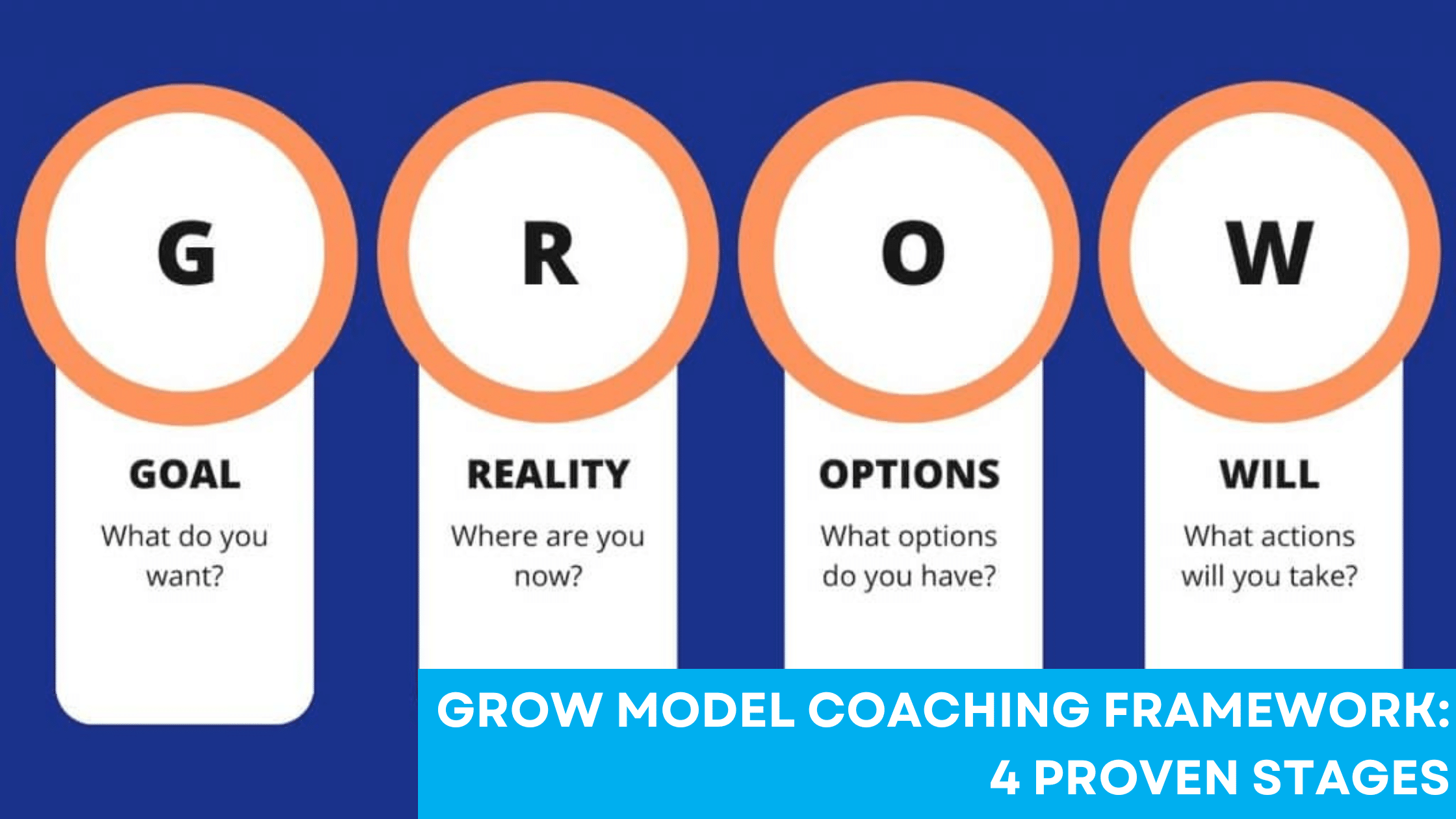
- The GROW Model coaching framework structures leadership conversations into four stages: Goal, Reality, Options, and Will.
- It shifts managers from giving instructions to guiding discovery, building capability rather than dependency.
- The stages are not strictly linear — skilled coaches move fluidly between them as the conversation needs.
- The framework only works when paired with genuine coaching skills: open questions, active listening, and a safe environment.
- Common failure modes include rushing the Reality stage, prescribing options, and skipping commitment.
The GROW Model coaching framework is the most widely used structure for coaching conversations in leadership today, yet most managers still improvise their one-on-ones. Developed in the 1980s by Sir John Whitmore and his colleagues, it converts vague check-ins into purposeful, outcome-driven dialogue. This article breaks down all four stages, the questions that power each one, and the mistakes that quietly undermine results.
Why the GROW Model Coaching Framework Still Dominates
A VP of Engineering once told me her one-on-ones had become status updates with feelings attached. She knew her senior engineer was stalling on a promotion case, but every conversation ended with her solving the problem for him. After one session restructured around GROW, he left with his own plan — and she had said almost nothing. That shift, from answer-giver to question-asker, is the entire point.
The framework endures because it is simple enough to remember under pressure and flexible enough to fit a five-minute corridor conversation or a quarterly review. Whitmore disseminated it through Coaching for Performance, now in its 25th edition and translated into 20 languages, making it the best-known coaching model in the world. It also has corporate credibility: Google uses it to teach its managers how to coach conversations.
The business case is hard to ignore. Research consistently shows coaching produces a strong return, with reliable ROI estimates ranging from 500% to 700%, and 77% of executives reporting a significant impact on at least one major business metric. The GROW Model coaching framework is a way for leaders to capture that return without hiring an external coach for every direct report.
Stage 1: Goal — Define What Success Looks Like
The Goal stage establishes what the person wants from the conversation and from the wider situation. This is not the same as the manager’s goal for them. The distinction matters: ownership is impossible if the objective was assigned rather than chosen.
Strong Goal questions sharpen vague ambition into something concrete:
- What do you want to walk away from this conversation with?
- What does a good outcome look like, specifically?
- How will you know you have achieved it?
- Why does this matter to you right now?
Whitmore advised pairing the Goal stage with SMART criteria — Specific, Measurable, Attainable, Realistic, Time-bound — so the objective is testable rather than aspirational. The Goal also acts as an anchor. When a conversation drifts, or the person gets stuck later, returning to the Goal restores energy and focus.
Stage 2: Reality — Examine the Current Situation Honestly
Reality is the stage most leaders rush, and rushing it is expensive. Its purpose is an unflinching, judgment-free assessment of where things actually stand. Often, describing the present situation reveals the solution on its own.
The temptation here is to interrogate or to lead the witness toward a conclusion you already hold. Resist it. Effective Reality questions stay open and curious:
- What is happening now, and what effect is it having?
- What have you already tried?
- What is within your control, and what is not?
- What is the real obstacle, as you see it?
This stage depends entirely on candor, and candor depends on safety. People will not describe the true state of a project, a relationship, or their own performance if they expect a penalty for honesty. That is why the GROW Model coaching framework works best inside teams with strong psychological safety — without it, the Reality stage produces a polished version of the truth, and every stage after it is built on sand.
Stage 3: Options — Generate Possibilities Without Prescribing
The Options stage explores possible routes from the current Reality toward the Goal. The single biggest error leaders make is supplying the options themselves. The moment you say, “Here is what I would do,” you have ended the coaching conversation and started a briefing.
Instead, draw options out. Let the person lead, and use questions to widen the field:
- What could you do, even if it seems unlikely to work?
- What else? (Ask this more than once — the third or fourth answer is often the best.)
- If there were no constraints, what would you try?
- Who has solved something similar, and what did they do?
Only after the person has exhausted their own thinking should you offer a suggestion, and even then, frame it as one option among several rather than the answer. The aim is a list of real choices, with the trade-offs of each understood.
Stage 4: Will — Secure Genuine Commitment
The Will stage converts options into action. Whitmore was emphatic that the “W” stands for will — the genuine intention to act — not merely “way forward” or “wrap up.” A plan without commitment is a wish.
Will questions test resolve, not just intent:
- Which option will you commit to?
- What is the first step, and when exactly will you take it?
- On a scale of one to ten, how committed are you to doing this?
- What might get in the way, and how will you handle it?
That scaling question is diagnostic. Anything below an eight signals a hidden obstacle, a misaligned goal, or low ownership — and it is worth looping back to an earlier stage rather than ending on false confidence. Close the loop by agreeing on how and when you will check on progress.
The GROW Model Coaching Framework Stages at a Glance
| Stage | Core Question | Leader’s Job | Common Mistake |
| Goal | What do you want? | Clarify a specific, owned objective | Imposing your goal on them |
| Reality | Where are you now? | Hold space for honest assessment | Rushing or interrogating |
| Options | What could you do? | Draw out possibilities | Prescribing the answer |
| Will | What will you do? | Secure committed action | Skipping commitment and accountability |
How to Apply the Framework Without Sounding Scripted
GROW is a guide, not a rigid script. Whitmore famously warned that “any dictator can use GROW,” — meaning the structure is worthless without real coaching skill behind it. Recent practitioner guidance echoes this, noting that even simple frameworks like GROW can be used incorrectly when applied mechanically.
A few principles keep it natural. First, the stages are not strictly sequential — an effective conversation usually opens with Goal and Reality, then moves freely between all four as needed. Second, your ratio of questions to statements should be heavily weighted toward questions. Third, listen to understand rather than to reply; the person’s answer often contains the next question.
For tech leaders, the highest-leverage place to practice is the weekly one-on-one. Pick one real challenge a direct report is facing and walk it through GROW rather than solving it for them. The first few attempts will feel slower. Within a month, you will notice the same people arriving with their own options already half-formed.
The GROW Model coaching framework endures because it solves a specific leadership problem: how to develop people without doing their thinking for them. Goal sets direction; Reality grounds the conversation in truth; Options expand the field; and Will turns intention into committed action. Master the questions, resist the urge to prescribe, and the framework quietly reshapes how your team approaches its own growth.