
Key Takeaways
- Hero leadership delivers speed today but fragility tomorrow.
- Dependency is a system design failure, not a talent issue.
- Scalable leadership shifts from control to clarity.
- Distributed decision-making outperforms centralized authority.
- The strongest organizations function smoothly in a leader’s absence.
Hero leader culture dominates many organizations, creating dependency disguised as commitment. While it can drive short-term results, it quietly undermines resilience, decision quality, and scale. Sustainable organizations are built when leadership capability is distributed rather than centralized.
The Hidden Cost of the Hero Leader Culture
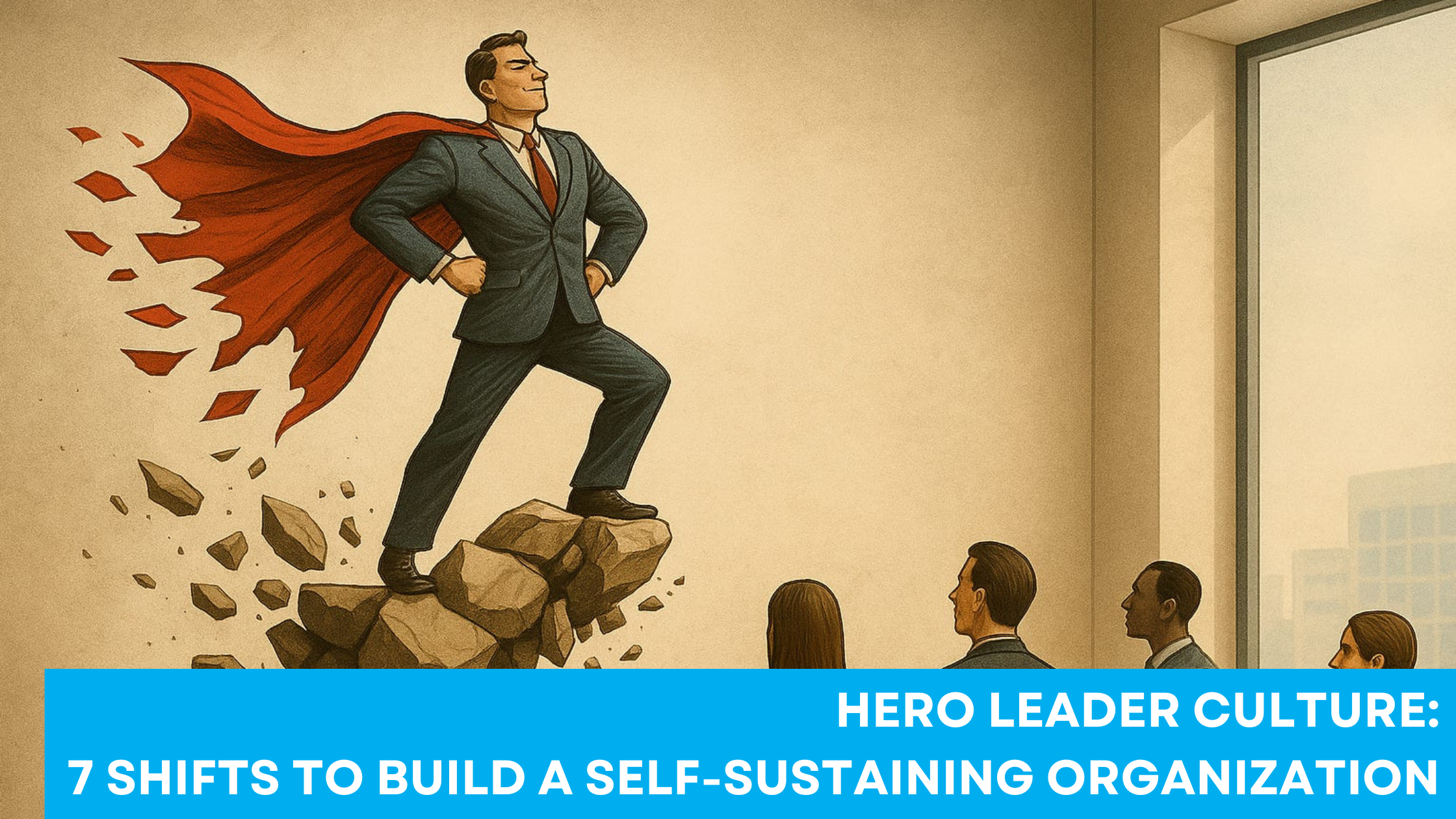
Hero leader culture rewards visibility, urgency, and personal intervention. Leaders who rescue projects, fix problems personally, and make themselves indispensable are often celebrated as high performers.
A global SaaS director once insisted on approving every major decision. When she unexpectedly took medical leave, initiatives stalled, and managers froze. Nothing was wrong with the team—the organization had simply been designed around one person.
This is the quiet failure mode of hero leadership. The organization appears effective—until the hero steps away.
Research on systems leadership shows that organizations overly reliant on individual leaders struggle during transitions because decision-making capability is not embedded across the system.
Why Organizations Default to Hero Leadership
Structural Incentives Reward Firefighting
Most performance systems unintentionally reward heroic behavior. Leaders who intervene visibly are perceived as “adding value,” while those who quietly build capability are overlooked.
Promotion criteria, bonus structures, and executive narratives reinforce urgency over sustainability. Over time, firefighting replaces foresight.
Permission-Seeking Replaces Psychological Safety
In hero-driven cultures, decision rights are unclear. When accountability is ambiguous, escalation becomes the safest option.
Gallup’s State of the Global Workplace report shows that low-autonomy environments correlate strongly with disengagement and reduced discretionary effort.
When teams wait for permission, momentum dies.

The Leadership Dependency Trap
Leadership dependency is not a people problem—it is a design flaw.
When leaders routinely:
- Override decisions late
- Rework team output
- Centralize approvals
- Step into execution
They train the organization to depend on them.
Systems leadership research explicitly rejects the heroic leader model, arguing that complex organizations require shared sensemaking and distributed authority to remain adaptive.
Dependency may feel efficient. It is not resilient.
What Scalable Leadership Actually Looks Like
Scalable leadership redefines the leader’s role—from problem solver to system architect.
Hero vs. Scalable Leadership
| Hero Leader Model | Scalable Leadership Model |
| Fixes problems personally | Builds problem-solving capability |
| Centralizes decisions | Distributes decision authority |
| Rewards loyalty | Rewards judgment |
| High control | High clarity |
| Short-term wins | Long-term resilience |
Employee engagement research shows that teams involved in decision-making are significantly more engaged and accountable than those operating under strict top-down control.
Clarity scales. Control constraints.
The Unlearning Process for Leaders
Unlearning hero leadership is uncomfortable because it challenges identity, not competence.
Stop Being the Bottleneck
A simple diagnostic question reveals everything: Where does work slow down because of you?
If decisions routinely wait for one person, the system is broken.
Replace Control With Guardrails
High-performing organizations define:
- What decisions do teams own
- What principles guide those decisions
- When escalation is required
This allows leaders to step back without losing alignment.
Normalize Intelligent Failure
Leadership research shows that organizations that encourage learning from failure adapt faster and retain senior talent longer.
Without failure tolerance, autonomy is performative.
Building a Culture That Doesn’t Depend on You
Codify Judgment, Not Just Process
Processes scale execution. Judgment scales leadership.
Resilient organizations document:
- Decision principles
- Trade-off logic
- Risk thresholds
This allows teams to act without waiting for permission.
Develop Leaders at Every Level
Leadership capability cannot be limited to senior roles.
Global leadership development research shows that organizations outperform when leadership skills are broadly distributed rather than concentrated at the top.
Every decision-maker must be a leader.
The Real Measure of Leadership Success
The ultimate test of leadership is absence.
If progress halts when a leader steps away, the system has failed. If momentum continues, leadership has succeeded.
Organizations built around hero leaders scale effort. Organizations built around systems scale impact.
Leadership that endures is quiet, intentional, and embedded in the decision-making process.