Key Takeaways
- Human judgment in leadership remains the decisive advantage in AI-powered organizations.
- AI copilots accelerate analysis but cannot replace accountability and ethics.
- Tech leaders must formalize override systems for high-impact decisions.
- Decision quality improves when reasoning is documented and challenged.
- Executive credibility now depends on how leaders interpret and contextualize AI.
Table of Contents
- Why Human Judgment in Leadership Matters More in Tech
- Where AI Copilots Excel—and Where They Mislead
- The Core Components of Human Judgment in Leadership
- Designing High-Performance Human–AI Systems
- Risk, Governance, and Accountability in AI Decisions
- Executive Presence in an Algorithmic Organization
- The AI Judgment Filter for Tech Leaders
Human judgment in leadership is now the defining advantage in organizations using AI copilots. As analytics, forecasting, and automation become ubiquitous, tech leaders are evaluated less on information access and more on how they interpret, challenge, and make decisions. This article explains why human judgment in leadership still outperforms machines—and how to operationalize it.
Why Human Judgment in Leadership Matters More in Tech
Technology organizations were the first to embed AI into daily workflows. Engineering, product, infrastructure, security, and data teams now rely on copilots for planning and prioritization.
This has reshaped leadership.
Speed has increased.
Volume has exploded.
Expectations have intensified.
Yet decision failures have not declined.
A Brief Field Anecdote
In 2024, a SaaS CTO approved a platform migration based on an AI-generated cost-benefit model. A senior architect flagged hidden dependency risks and vendor lock-in. The model had no access to undocumented integrations. The CTO paused the rollout, avoiding a six-month outage. The difference was not better data. It was human judgment in leadership applied at the right moment.
The Structural Shift
AI now handles:
- Capacity forecasting
- Incident pattern detection
- Technical debt analysis
- Customer churn modeling
- Roadmap optimization
Leaders must handle:
- Strategic trade-offs
- Political consequences
- Reputational exposure
- Regulatory implications
Human judgment in leadership has become the main value-add.
Where AI Copilots Excel—and Where They Mislead
To use AI effectively, tech leaders must understand its strengths and limits.
Where AI Copilots Deliver Real Value
AI performs best when problems are:
- High-volume
- Data-rich
- Pattern-based
- Low-ambiguity
Examples include:
- Infrastructure cost modeling
- Release risk prediction
- Log analysis
- Incident classification
- Documentation synthesis
In these domains, automation improves consistency and speed.
Where AI Copilots Become Dangerous
AI struggles when decisions involve:
- Cross-functional politics
- Ethics and compliance
- Customer trust
- Regulatory exposure
- Long-term platform risk
These are precisely the areas where human judgment in leadership matters most.
According to McKinsey’s 2025 AI workplace report, most AI failures stem from governance gaps, not technical limitations.
Leaders often accept AI output because it feels authoritative.
That is not leadership.
That is abdication.
The Core Components of Human Judgment in Leadership
Human judgment in leadership is not intuition. It is structured decision-making under uncertainty.
Elite tech leaders consistently demonstrate five capabilities.
1. Context Intelligence
Understanding what data cannot represent:
- Informal power structures
- Vendor politics
- Regulatory mood
- Customer sentiment
2. Causal Reasoning
Separating correlation from causation.
AI shows patterns.
Leaders identify mechanisms.
3. Trade-Off Management
Every technical decision sacrifices something:
- Speed vs stability
- Innovation vs security
- Cost vs resilience
Human judgment in leadership makes these trade-offs explicit.
4. Ethical and Legal Framing
MIT research shows that biased inputs reproduce biased outputs: Leaders must define boundaries before optimization begins.
5. Accountability Ownership
AI has no reputation.
Executives do.
Human judgment in leadership means standing behind outcomes.
Designing High-Performance Human–AI Systems
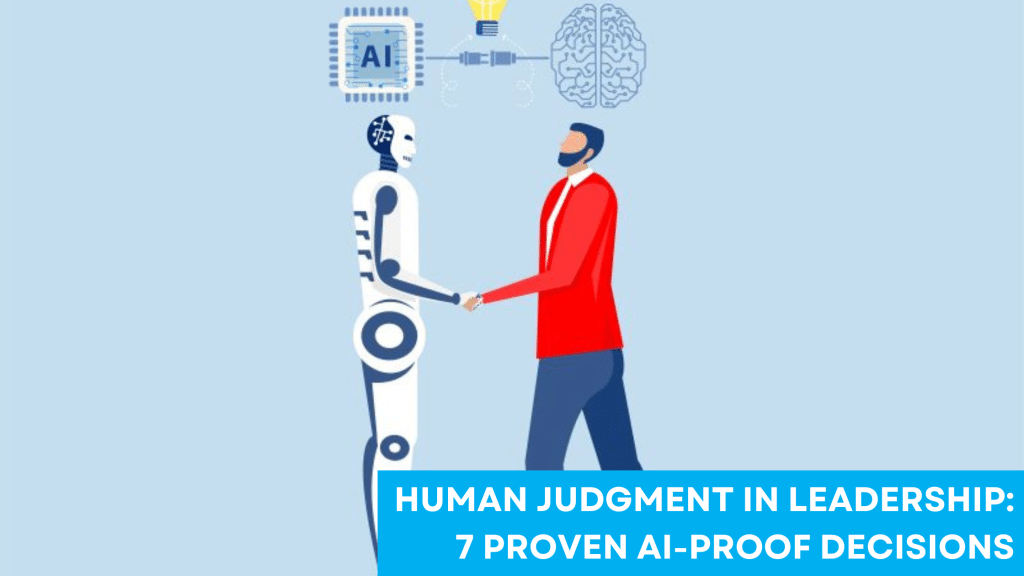
Most companies claim to operate “human-in-the-loop” systems. Few implement them rigorously.
The Operating Principle
AI informs.
Leaders decide.
Never reverse this order.
Decision Allocation Matrix
| Decision Type | AI Role | Human Role | Risk Level |
| Capacity Planning | Primary | Validation | Low |
| Hiring & Promotion | Screening | Final Authority | Medium |
| Platform Migration | Modeling | Decision Owner | High |
| Pricing Strategy | Scenario Analysis | Direction Setting | Very High |
| Compliance | Monitoring | Accountability | Critical |
This structure protects decision quality.
System Design Implication
High-performing tech organizations formalize:
- Override protocols
- Escalation rules
- Decision logs
- Bias audits
Human judgment in leadership shifts from personal to institutional.
Risk, Governance, and Accountability in AI Decisions
AI complicates responsibility.
When systems fail, leaders often hide behind tools.
That erodes trust.
The Accountability Paradox
The more AI you use, the more leadership responsibility increases.
Why?
Because delegating cognition does not delegate liability.
Three Governance Practices
1. Decision Traceability
Document:
- AI recommendation
- Assumptions
- Human rationale
- Final call
2. Structured Red-Teaming
Assign someone to challenge:
- Missing variables
- Political blind spots
- Ethical risks
3. Reasoning Audits
Review how decisions were made, not just outcomes.
CIO.com highlights governance gaps as the primary GenAI risk; human judgment in leadership protects organizations from algorithmic abdication.
Executive Presence in an Algorithmic Organization
As analysis becomes commoditized, leadership differentiation shifts to presence.
Stakeholders now judge leaders on:
- How they explain uncertainty
- How they challenge models
- How they communicate trade-offs
- How they embody accountability
This aligns directly with the 3 Cs of Executive Presence:
- Clarity.
- Confidence.
- Composure.
Without these, AI amplifies dependency.
With them, it multiplies influence.
The AI Judgment Filter for Tech Leaders
High-performing executives use structured filters to activate human judgment in leadership.
The JUDGMENT Filter™
Before accepting AI output, ask:
- Context – What does the model not know?
- Stakeholders – Who bears unintended costs?
- Time Horizon – What happens in 12–24 months?
- Ethics – Can this be defended publicly?
- Reversibility – Can we recover if wrong?
If any answer is weak, override.
Practical Rule
- Reversible + Low Impact → Lean on AI
- Irreversible + High Impact → Lead Personally
No exceptions.
Handling Executive Disagreement
When AI contradicts leadership instinct:
- Present the model
- Expose blind spots
- State your decision
- Define monitoring metrics
That is human judgment in leadership in action.
Conclusion
Human judgment in leadership is not threatened by AI. It is exposed.
AI raises the analytical floor.
Leaders define the strategic ceiling.
Tech executives who win will build systems where machines accelerate thinking and humans own meaning, ethics, and accountability.
Human judgment in leadership remains the ultimate competitive advantage.