
Key Takeaways
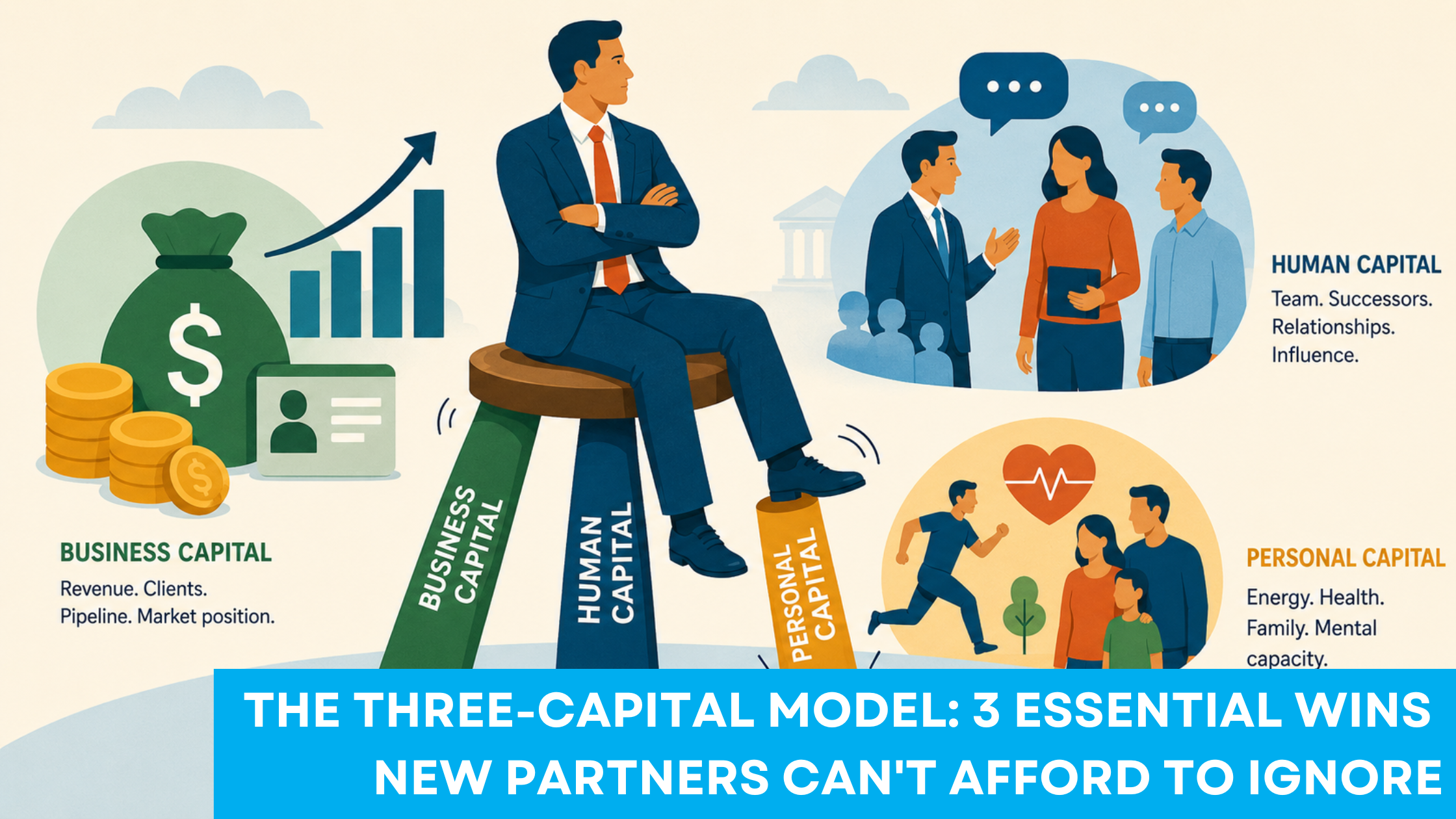
- The Three-Capital Model frames a new partner’s success across Business Capital, Human Capital, and Personal Capital — like a three-legged stool.
- Most new partners over-invest in business capital because it’s the only leg the firm visibly rewards.
- Performance does not collapse when one capital weakens — it collapses when the imbalance is sustained for too long.
- A simple 1–10 scoring exercise surfaces blind spots in minutes and reframes how partners prioritize their week.
- Rebalancing does not require less ambition; it requires deliberate investment in the legs that don’t show up on the P&L.
The Three-Capital Model is the framework I most often introduce to new partners at law firms, consulting houses, and accounting practices — usually within their first eighteen months in the role. It exposes the quiet trap that catches almost all of them: the leg of the stool they never built. This article explains the three capitals, the pain each one causes when neglected, and a 1–10 exercise that surfaces imbalances in minutes.
Why the Three-Capital Model Matters for New Partners
A new partner, I’ll call him Tom, came into a coaching session two years after his promotion. Business was booming — pipeline, clients, billings, all eights and nines. Then I asked him to score his team strength and his family life. He went quiet, then said: “Threes. Maybe twos.” Six months later, his best senior left, and a flu he couldn’t shake turned into three weeks off. The stool had been wobbling for a year. He hadn’t seen it.
Tom is the rule, not the exception. The biggest mistake new partners make is investing exclusively in business capital — because it’s the leg the firm measures, celebrates, and writes into their compensation. But 60% of consultants cite business development as their single biggest challenge, and the pressure does not let up after the partnership vote. It intensifies. Origination targets get harder, client demands compound, and the rest of life starts paying the bills.
The Three-Capital Model rebuilds the picture. It says, “Yes, you need revenue.” But you also need the people who deliver it with you, and the personal capacity to actually do the work. Weaken any one leg, and the stool eventually falls — usually at the worst possible moment.
Leg One: Business Capital — The Visible Pillar
Business capital is everything the partnership track was designed to measure: revenue, clients, pipeline, and market position. It’s the leg every new partner instinctively invests in, because it’s the one with a number attached.
The pain points are familiar. Origination is hard and slow — meaningful client relationships take years to mature, and most new partners feel pressure to produce now. Pipeline visibility is patchy. Market position is fragile, especially in commoditized practice areas. And under stress, most partners default to more activity — more pitches, more lunches, more late-night decks — when the real lever is sharper positioning and harder choices.
Business capital is real, and it does need attention. The trap is treating it as the only thing that needs attention. The strongest partners I’ve coached treat business capital as roughly one third of their job — not the whole game.
Leg Two: Human Capital — The Leg You Cannot Build Alone
Human capital covers your team, your successors, your relationships across the firm, and your influence inside it. This leg is what separates a partner who carries a book from a partner who builds a practice.
The pains here are subtler but more dangerous. The senior associate you’ve been meaning to mentor finally leaves. The handover to your eventual successor never starts. The partners you’d need to back your next big bet barely know you. Influence inside a firm is built quietly, in small interactions, over years — and new partners almost always under-invest in it because the return is invisible until you need it.
This is also where the Peter Principle quietly applies — partners promoted for technical excellence are suddenly judged on commercial leadership, mentoring, and firm citizenship. The skills that made you a partner are not the skills that make you a successful partner.
Leg Three: Personal Capital — The Leg Partners Sacrifice First
Personal capital is energy, health, family, and mental capacity. It is the leg new partners sacrifice first, because in the short term, nobody notices — including, often, themselves.
The pain pattern is consistent across firms and geographies. Sleep erodes first. Exercise disappears. Family time gets compressed into the gaps between deliverables. Concentration starts to fray, and the partner compensates with longer hours, which accelerates the decline. The legal profession has been candid about this — a senior partner profiled by Scale LLP described how the Biglaw culture left her unable to “choose between professional excellence and personal well-being” until she left the traditional model entirely.
The damage is rarely dramatic. It looks like a fortnight of low-grade illness. A judgment call you would have got right two years ago. A partner meeting where you didn’t speak because you couldn’t quite think clearly. Personal capital depletion is invisible until it isn’t — and by then, the cost is months, not weeks. Protecting it is fundamentally a time stewardship problem: not a willpower one.
The Three-Capital Model at a Glance
| Capital | What It Covers | Typical Pain When Neglected | Most Common Failure Mode |
| Business | Revenue, clients, pipeline, market position | Stalled origination, weak pipeline, lost market share | Over-activity replacing strategy |
| Human | Team, successors, internal relationships, influence | Key departures, no succession, low firm influence | Treating it as “soft” until it’s too late |
| Personal | Energy, health, family, mental capacity | Burnout, judgment errors, relationship damage | Sacrificing it for short-term wins |
The 1–10 Diagnostic: Find the Wobble in Five Minutes
The exercise I use with every new partner is deliberately simple. Score yourself today, honestly, from 1 to 10 across three areas:
- Business — pipeline, client health, market position
- Human — team strength, successor readiness, internal influence
- Personal — energy, health, family, mental capacity
Then ask the question that does the real work: what happens if one of these drops to a 3 while the others stay at 8?
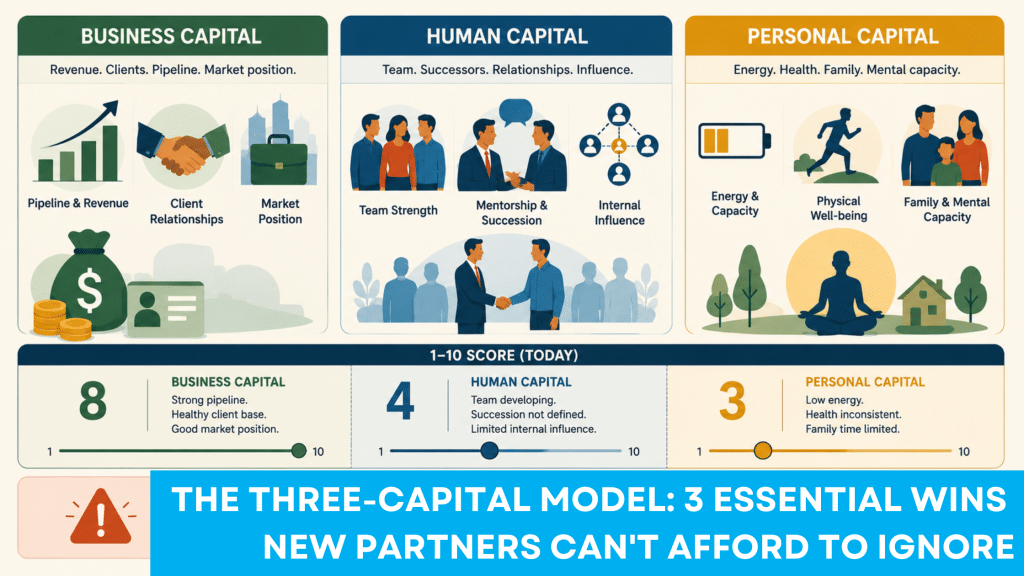
The answers come fast, and they are usually uncomfortable. A 3 in personal capital means the 8 in business is unsustainable — you cannot run a pipeline on three hours of broken sleep. A 3 in human capital means the 8 in business is borrowed — when the senior who really runs your largest matter leaves, the 8 drops to a 5 overnight. The diagnostic does not give you answers. It gives you the right questions, and that is usually enough to redirect a quarter’s worth of effort.
Run this every 90 days. The scores will move, and that movement is the most useful management dashboard a new partner has.
How to Apply the Three-Capital Model in Your First 90 Days
Three concrete habits separate partners who use the Three-Capital Model from those who just nod at it.
First, block calendar time for human and personal capital with the same seriousness as a client call. If team development and family dinners are negotiable and pitches are not, you’ve already lost. The calendar is the truest expression of strategy.
Second, define a leading indicator for each leg. Business capital usually has them already (pipeline value, hit rate). Human capital needs them invented — a successor identified, two mentoring conversations a month, one cross-practice relationship deepened per quarter. Personal capital needs the simplest ones — hours of sleep, days of exercise, evenings at home — tracked without judgment.
Third, find one person who will tell you the truth about the legs you can’t see. A coach, a mentor, a spouse, a peer outside your practice. New partners rarely fall because they didn’t know — they fall because nobody was close enough to point at the wobble.
The Three-Capital Model is not a wellness slogan with a diagram. It’s a structural account of what makes a partner’s career stand up over twenty years instead of five. Business capital pays the bills. Human capital builds the practice. Personal capital is the one that lets you do either. Score yourself honestly across the three, identify the leg that’s drifting toward a 3, and invest there before the stool reminds you why all three legs matter.